
The Story of Peñaranda (and more...)
Revolutionary Flag of Hon. Florentino Peñaranda
-
Hon. Florentino Peñaranda's revolutionary flag with his name handwritten on the edge and what looks like dried blood stains.
-
The full flag right side below with the red on top, symbolizing war. The author and his relatives are still trying to decipher what the symbol in the middle means
-
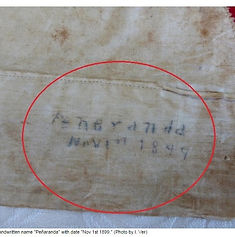
Close-up of handwritten name "Peñaranda" with date "Nov 1st 1899."
Thanks to Mr. Oscar Peñaranda
http://www.positivelyfilipino.com/magazine/a-reunion-of-strangers



Florentino Peñaranda 1st July, 2015
The last officer of Aguinaldo's Revolutionary army to surrender to American officers.
Florentino Peñaranda (June 18, 1876 – Sept 3, 1938) was a Filipino educator, legislator and politician in the province of Leyte. He was also an officer of the revolutionary forces in Samar and Leyte who fought for Philippine independence against the Americans. During peace time, Peñaranda ran for elections and won a seat representing the 3rd district of Leyte in the First Philippine Assembly from 1907-1909.
FLORENTINO PEÑARANDA was born on June 18, 1876 in the town of Barugo, province of Leyte. He studied at the Escuela Normal de San Francisco Xavier (located in Padre Faura Street, Ermita, Manila) ran by Spanish Jesuits. After completing his studies, Peñaranda set up a school for children in his hometown and forthwith launched his career in teaching.
Peñaranda was married to Francisca Villasin, a native of Barugo with ancestral roots from Bantayan Island off Cebu. They had nine children, two boys and seven girls, one of whom died in her young years. Peñaranda died on September 3, 1938.
A street is named in Peñaranda's honor in his birthplace, Barugo as well as in the neighboring town of Tunga in Leyte.
Historian and writer Manuel Artigas of the Federalista Party who was born in Panalaron, Tacloban also ran for the same seat for the 3rd District of Leyte but Artigas lost to Peñaranda.
To read more information about Hon. Florentino Peñaranda visit
-
https://en.wikipedia.org/wiki/Florentino_Pe%C3%B1aranda
-
https://www.facebook.com/pages/Florentino-Pe%C3%B1aranda/723916887635705?fref=ts#

The Monument of Jose Maria Peñaranda
..... in Legazpi City Albay Bicol inscriptous letters read:
Jose Maria Peñaranda, Govermor of Albay (1834-1843)
A distinguished Military Engineer, he strengthened the provinces forts and offshore defenses aginst pirates raid, built roads and bridges, helped construct the provincial capitol and the cathedral of San Gregorio Magno. Promoted agriculture and industry; and districtly showed excellent governatorial administration that transformed the province of Albay into a modern and progressive community.
[Ang Spanish government ay may tinatawag na "funding'" sa Pilipinas kung saan ay ginagastusan nila ang alin mang Project Development ng dating Spanish Colony thru "Agencia Española de Cooperation International para Desarolo (AECID).]

Jose Maria Peñaranda 23rd June, 2015
Adjutant to Governor-General Pascual Enrile y Alcedo (1830-1835). A military engineer, Peñaranda surveyed the lands in northern Luzon and constructed the highways of the Ilocos region. He was made corregidor of Albay on May 14, 1834 until 1843. He promoted agricultural development in the province, and effected the building of bridges and other ways of communication to bring the eastern and western coasts of Luzon into closer contact. Conducted successfully an expedition which overthrew the stronghold of Muslim pirates in Masbate, and later established a signal system on the islands of the south to watch the movements of pirates. Died in Manila in 1849.
Collection: Lopez Memorial Museum
Image type: Reproduction: Lithograph
Subjects--Chronological Terms: 1876
Subjects--Topical Terms: Spaniards
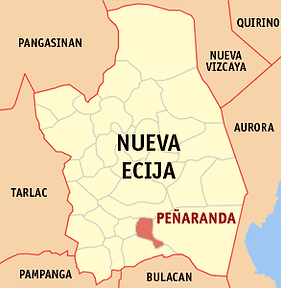
Peñaranda, Nueva Ecija 23rd June, 2015
Peñaranda is a fourth class municipality in the province of Nueva Ecija, Philippines. According to the 2010 census, it has a population of 27,410 people.[3]
It is bordered by municipalities of General Tinio and San Leonardo and the city of Gapan.
The area was originally called Mapisong, and it was a part of the municipality of Gapan. The area was organized into a municipality by José Maria Peñaranda, a Spanish engineer, and subsequently named after him.
Peñaranda was once known for its high quality crop called ikmo, a plant used by older Filipinos as a chewing substance. Recently however, the crop is on the brink of extinction. Rice remains a flourishing farm produce.
World War II
In December 1941, the Japanese fighter and bomber planes was found invading the town municipalities in Peñaranda during the Japanese Invasion. In 1942, the Japanese Occupation forces entered in Peñaranda, Nueva Ecija. The established of the military general headquarters, garrisons and concentration camps of the Imperial Japanese Armed Forces was stationed and built from the town municipality.
In 1942 to 1945, the ambushed by the local guerrilla groups and Hukbalahap Communist resistance was around the conflicts and insurgencies from the municipal town in Peñaranda and attacks the Japanese. When the guerrillas and Hukbalahap Communists groups there retreated from the Japanese. Before the arrival by the local Filipino troops and officers of the Philippine Commonwealth Army units was liberated the municipal towns.
In 1945, entering to the Philippine Commonwealth Army troops of the 2nd, 21st, 22nd, 23rd, 25th and 26th Infantry Division of the Philippine Army took in Peñaranda, Nueva Ecija together with the local recognized guerrilla units and Hukbalahap Communist fighters we fronted the battles against the Japanese troops by defeated from successful to the Philippine troops and recognized guerrillas beginning the Invasion of Peñaranda during World War II.